


When was the last time you called your own health system?
Not as the leader who runs it. As a patient. You dialed the number on your own website, sat through the phone tree, and tried to get one real question answered.
Now try it as someone else. Someone who works a night shift and can only call during the hours no one picks up. Someone whose first language isn’t English. Someone who has been burned by healthcare before and is spending real courage to try one more time.
The leaders who have actually done this come back changed. They can’t un-see what they find.
The ones who haven’t are running organizations where a share of their patients have already decided whether they’re coming back. The system just doesn’t know it yet.
Here is what I’ve learned mapping that gap for a living. You almost never lose a patient in the exam room. You lose them everywhere else.

Patient experience was never really about the exam room
When most leaders hear the words patient experience, they picture the visit. The bedside manner. The clinical outcome.
Now think about everything wrapped around the fifteen minutes with a clinician. Finding a number that works. Getting through the phone tree. The wait. The handoff to a department that doesn’t have your chart. The bill that lands three weeks later with a figure no one warned you about. The follow-up that never comes.
The care itself matters, and it is yours to own too. But it is a small slice of the time a patient actually spends with you, and it is rarely where the relationship breaks. Everything around it is the part that quietly decides whether they come back.
Every one of those touchpoints is a moment of decision. Below the level of words, the patient is deciding whether this is a place that sees them or a place that processes them. Each moment either adds to their trust or spends it down. And trust is what decides whether they book the next appointment, follow the plan, send you their family, or quietly start shopping. That is revenue, built or eroded one touchpoint at a time.
Patients rarely judge you on clinical quality alone. Most can’t assess it directly. What they can feel is whether you were easy to trust. And that verdict gets reached in the parts of the journey almost no one is measuring.
Where this work comes from
I didn’t come to this from a whiteboard. I came to it from my aunt Shadidi.
She spent her life showing up for everyone else, an activist and an advocate for her community. But when it came to her own health, she delayed care for years. Not because she was busy. Because she was afraid, and given the system’s history with Black and brown communities, she had every reason to be.
She died of cancer in 2005, earlier than she should have.
I hear versions of her story everywhere I go. People who avoid care not because they don’t value their health, but because the system never earned their trust.
Then I spent a career on the other side of it. I supported Fortune 100 healthcare payers and providers building experience strategies that maximized profitability, usually by solving problems that had no playbook, no best practices document on a shelf, no vendor with a pre-built solution.
So when I went looking for a way to measure whether an organization was actually earning trust, instead of just scoring satisfaction, and found nothing, I did what I always had. I built it.
That’s the Trust Algorithm.

What if we’ve been measuring the wrong thing?
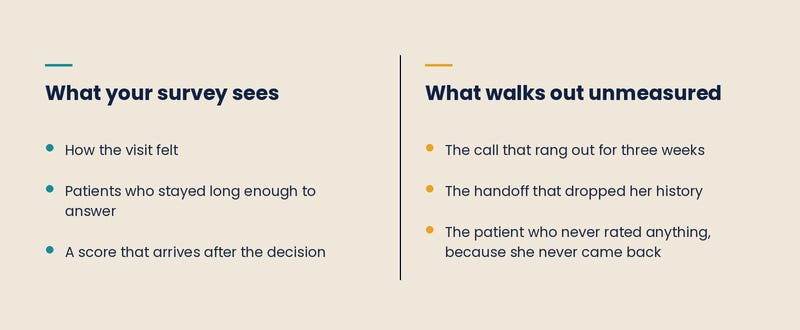
Healthcare got good at measuring satisfaction. HCAHPS surveys if you run a hospital. Star ratings and Google reviews if you run a practice. Press Ganey and the monthly feedback report either way.
And satisfied patients leave anyway. Around 68% of patients who rate their experience highly will still switch. Accenture, benchmarking 21,000 consumers, found that nearly 80% of the patients who leave a provider do it over ease and experience, not clinical care (Accenture, The Difference Between Loyalty and Leaving).
So the instrument was pointed at the wrong target the whole time.
What actually predicts whether a patient comes back, whether they send you their family, whether they trust you enough to follow through on the care plan, is not satisfaction. It’s trust.
Here is the distinction I keep coming back to. Satisfaction is transactional. Experience is longitudinal. Satisfaction tells you how one moment felt. Experience, and the trust it builds, tells you who is still going to be here next year.
And trust matters more right now than it ever has, because your patients stopped grading you against other health systems. Amazon tells them where the package is at every step. Their bank warns them before a payment is due. They settle a billing dispute at midnight without speaking to a soul. That is the bar now. Healthcare is the one place people often need help the most, and it’s also where the distance between what they need and what they actually experience is the widest.
Trust is the algorithm underneath your revenue
Here is the part most organizations get wrong. They treat trust as a mood, a soft thing patients either arrive with or don’t.
It isn’t soft. Trust is the algorithm running underneath every dollar a patient is worth to you.
In that same Accenture benchmark, patients who trust their provider are five times more likely to stay, and almost seven times more likely than patients who don’t trust them at all (Accenture). That is retention, referral, and revenue, mostly decided before a clinician ever walks in the room.
And the algorithm is the same whether you run a 400-bed system or a three-provider practice. Only the size of the number changes.
I call it the Trust Algorithm. Each signal marks a place where trust is measurably won or lost, and each one earned its spot because the research keeps pointing there. Here is the why behind each pillar, and what it looks like when it breaks.
Accessibility. In Accenture’s benchmark of 21,000 consumers, 71% named access as the single biggest factor in choosing a provider, and access friction drove switching at nearly double the rate of a poor clinical experience (Accenture). Patients decide whether they can trust you before they ever meet a clinician, on hold and in the scheduling queue. What it looks like on the ground: the community you serve defines what access means. A rural system serving agricultural workers and a plan with high limited-English proficiency need different doors. Most organizations build access for the patient they imagined, not the patient they have.
Resolution. That same benchmark found patients who experience a provider as very easy to work with are nine times more likely to stay than those who find them hard to deal with (Accenture). Effort is a tax patients quietly resent, and a problem is a fork in the relationship. On the ground, most organizations track first-contact resolution and assume they’ve covered this. They’re measuring whether the call ended, not whether the patient’s problem did. And the gap falls hardest on patients with language barriers or low health literacy.
Continuity. This is not about seeing the same clinician every visit. It’s about whether a patient can move between your channels, the phone, the portal, a text, the front desk, and pick their journey up where they left off instead of starting over. In a 2025 benchmark of 3,000 consumers, nearly 70% said they will walk away from a provider when communication doesn’t meet expectations, and the frustration they name most is being made to repeat themselves across disconnected systems (Medical Economics, 2025). On the ground, when a patient gives their name, date of birth, insurance, and reason at every handoff, the system is telling them plainly that it does not know them. Context has to travel with the patient. And much of today’s AI investment is very good at closing a single transaction and very bad at carrying that thread across channels. A continuity crisis hiding inside a technology purchase.
Proactivity. Waiting for the patient to chase you is where trust and revenue leak together. Miss one appointment and a patient becomes nearly 70% more likely to never return within 18 months, while proactive outreach measurably pulls that number back (no-show and attrition research). Proactivity is helping people through care they don’t know how to get through alone. On the ground, does anything in your system confirm a referral actually got booked. Do you close care gaps before they harden into crises. The patients who gain most from proactive navigation are usually the ones already carrying the heaviest barriers.
Recovery. There is a counterintuitive finding in the service research, the service recovery paradox: handled well, a failure can leave a patient more loyal and more trusting than if nothing had gone wrong at all (service recovery research). On the ground, most organizations don’t have recovery infrastructure. They have complaint-closing infrastructure. Very different things. Real recovery needs frontline staff who are allowed to act, and an organization willing to name what actually happened.
Think back to my aunt Shadidi. She didn’t delay care because she couldn’t find a doctor. She delayed it because the system had never earned her trust, and she was far from alone.
These five signals don’t fail equally. They fail more often, and more severely, for the patients and the whole communities who already carry the most reasons to doubt you. That’s not a political statement. It’s an operational finding. Deloitte put the cost of health inequities at $320 billion a year (Deloitte Health Equity Institute), and the trust eroding in communities like hers is a large part of how that bill gets paid. It rarely shows up in your survey scores until years later, when it’s expensive.
Trust isn’t a feeling your patients bring you. It’s the algorithm that decides whether they come back, refer, and keep spending on their care. Most organizations are running it blind.

The AI question everyone is asking backward
Most of the AI money in this industry has been chasing one thing: cost. Cut call volume. Cut headcount. Automate the transaction. I understand why. The financial pressure is real.
But change the question.
Instead of asking what AI can replace, ask what it can free up. Some functions should be automated, the routine reminders and the basic navigation, because your people shouldn’t be spending their day on those. Some patient journeys need staff with AI working beside them, surfacing the right thing at the right moment so a human can actually perform. Do both of those well and something interesting happens. You create capacity. Real capacity.
And that capacity does not have to go back into cost reduction. It can go into the relationship work and the revenue work that only people can do. Proactive outreach. Complex navigation. The conversation that earns a patient’s loyalty. That is the difference between using AI to shrink the business and using it to improve profitability across the whole P&L, through growth and retention, not just a smaller headcount.
Technology should make the human moments more dependable. It should never stand in for them.
What the trust gap is actually worth
This is where trust stops being an abstraction and starts being a number on your P&L.
The five signals don’t map to a single number. They map to a whole set of them, because every signal touches revenue somewhere. When I run a full Trust Algorithm Diagnostic, the same picture shows up again and again. Abandoned calls that never became appointments. No-shows a better outreach protocol would have caught. Care gaps that closed late, or never. Readmissions a single proactive call could have stopped. Billing friction that quietly ended the relationship. Patients who left because they were never made to feel known. Referrals that walked to a competitor.
The size of the number scales with you. The leak doesn’t discriminate. Miss one appointment and a patient is nearly 70% more likely to never return within 18 months (no-show and attrition research). For an independent practice, no-shows alone run to roughly $150,000 a year. For a mid-sized health system, the full set of levers adds up to $3.5 to $7.6 million.
That’s not upside. That’s what reactive-only operations are leaving on the table right now, at every size.
And if you run a hospital, that is before Value-Based Purchasing enters the math, where Medicare withholds 2% of your operating payments and a quarter of that pool rides on your patient experience scores (CMS Hospital VBP). Every five-point improvement there is worth roughly a full point of margin.
The financial case for trust isn’t abstract. It’s sitting in your own data. You just need the right instrument to read it.

What this means for you
Start with the thing that costs nothing.
This week, call your own main line. Not as the executive or the owner who signs the vendor contract. As a patient with a real question, on hold, moving through the queue. Notice the first place you’d give up if you didn’t own the building. Then pick one of the five signals and audit it against what you just lived, without grading on a curve.
That single exercise will tell you more than a quarter of survey data.
When you’re ready to see where the money is leaking, the Revenue Leaks Calculator shows you where to look. It’s free, and it’s built to surface the gaps.
The full Trust Algorithm Diagnostic goes further. It maps all five signals to the full set of revenue levers, tells you what your specific gap is worth, and hands you the sequence to close it, at your scale.
You can’t hear the patients who left quietly. Your data can, the moment you start measuring the right thing.
Let’s get to work,
Ebony

Ebony Langston is the founder of The Patient Experience Strategist™ and a fractional Chief Experience Officer for healthcare organizations rebuilding patient trust as a margin strategy. With more than 20 years of operations experience supporting Fortune 100 healthcare organizations, she now works with leaders across the field, from health system C-suites and patient experience teams to independent and small-group practice owners. She writes weekly for the executives and clinicians turning patient experience from a cost line into a revenue engine.
Connect on LinkedIn | Subscribe to The Patient Experience Strategist
Thanks, excellent read. You're right, there's a new standard in healthcare. Patients aren't benchmarking us against other systems anymore; they're benchmarking us against any service that delivers convenience.